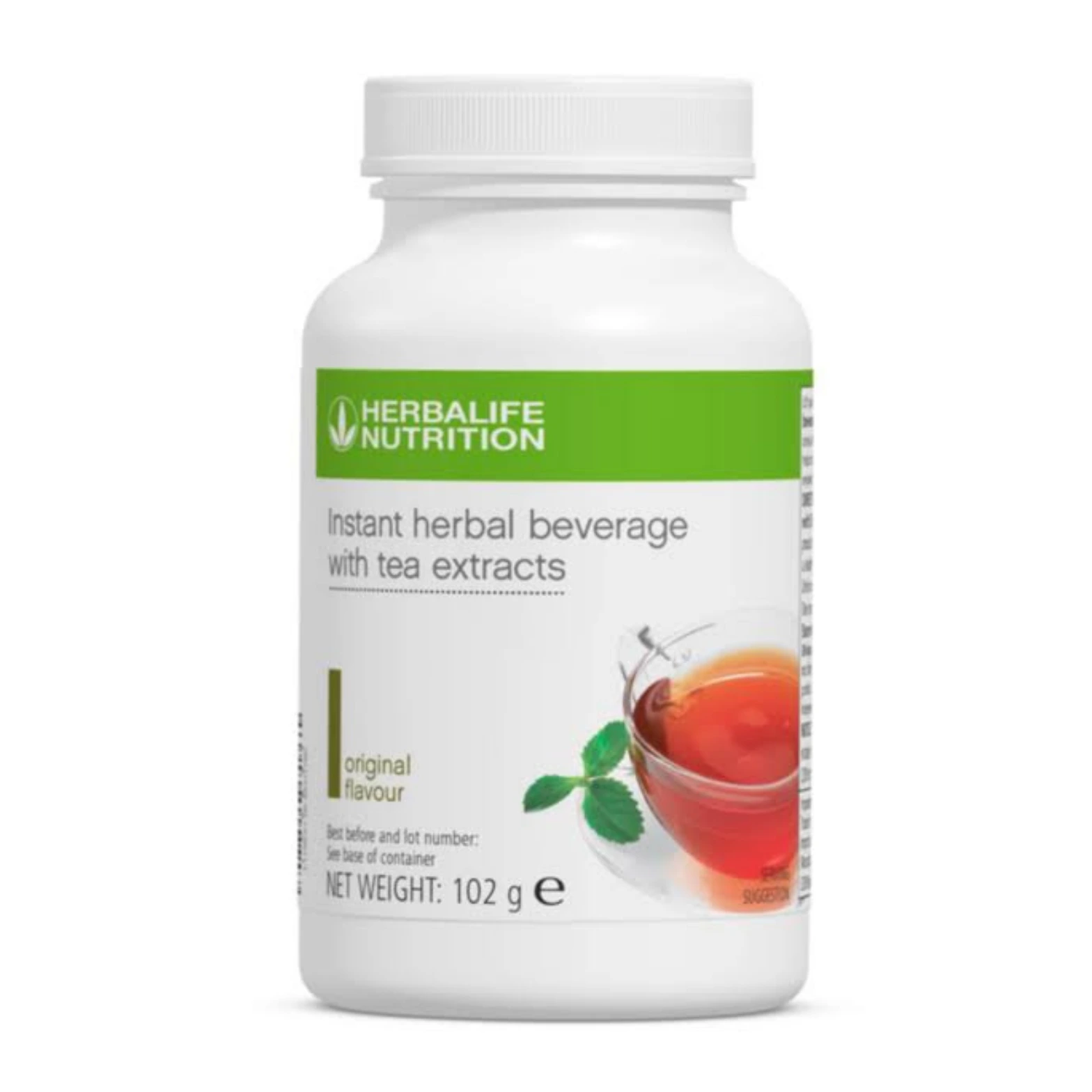
Herbalife Tea Benefits: Ingredients, Caffeine Content & The Science Explained

By Dogus Dilan, Herbalife Independent Wellness Coach  ·  Last updated 9 August 2026

Herbalife’s Instant Herbal Beverage with Tea Extracts delivers 87.5mg of caffeine and just 6 calories per serving, from a blend of Orange Pekoe black tea and green tea extract. The 75mg EFSA-recognised caffeine threshold for alertness and concentration is met, and the green tea catechin research is real — but it’s specific to the ingredient category, not a clinical claim about this exact blend. Below: the full formulation, the science, safe daily limits, and how it compares to a regular cup of tea or coffee.

Herbalife Instant Herbal Beverage Mango Dragon Fruit 102g, the newest flavour in the tea range

If You’ve Ever Wondered How a Single Cup of Tea…

…can boost your energy, sharpen your concentration, and still come in at under ten calories, you’re not alone. Herbalife’s Instant Herbal Beverage with Tea Extracts — known to most customers simply as “Herbalife Tea” — has become one of the most searched-for products in the entire Herbalife range, and it’s easy to see why.

Unlike an ordinary builder’s brew, this isn’t just black tea in a bag. It’s a carefully formulated blend of Orange Pekoe black tea, green tea extract, hibiscus flower powder and cardamom seed extract, designed to deliver a precise dose of caffeine alongside plant polyphenols — all within a six-calorie serving. In this guide, we break the formulation down ingredient by ingredient, look at what peer-reviewed research says about green tea catechins and thermogenesis, cover the EFSA-recognised safety limits for daily caffeine intake, and answer the questions UK customers ask most often before buying.

What Is Herbalife Tea? Ingredients and Formulation

Herbalife’s Instant Herbal Beverage with Tea Extracts is not a single-ingredient tea in the traditional sense — it’s a formulated blend of four core botanical components, each contributing a specific role to the final drink. The Original flavour’s full ingredient list, as declared on the official UK product label, is shown below.

Herbalife Instant Herbal Beverage (Original) — full ingredient breakdown
IngredientApprox. ConcentrationRole in the Formula
MaltodextrinBulking agentCarrier base for the powder
Green tea leaf extract (Camellia sinensis L.)17.7%Source of catechins, including EGCG
Orange Pekoe black tea leaf extract (Camellia sinensis L.)4.7%Traditional black tea character and additional caffeine
Caffeine powderDelivers a standardised 87.5 mg of caffeine per serving
Hibiscus flower powderTartness and polyphenol content
Cardamom seed extractTraditional flavour note
Natural flavouringVaries by flavour (Original, Lemon, Peach, Raspberry, Mango Dragon Fruit)

Two details are worth noting here. First, the green tea used is water-extracted rather than simply dried and ground, which Herbalife states is intended to preserve the same spectrum of compounds found in a traditionally brewed cup of green tea. Second, this is a genuine dual-tea blend — it draws caffeine and catechins from both green tea and Orange Pekoe black tea, which is part of why the caffeine content sits meaningfully higher than a single cup of green tea alone (which typically provides somewhere in the range of 25–30 mg).

It’s worth flagging that the exact ingredient list shifts slightly by flavour. The Lemon, Peach, Raspberry and Mango Dragon Fruit variants add a natural sweetener derived from stevia leaf, not present in the unsweetened Original. If you have a specific sensitivity, it’s always worth checking the individual product label for the flavour you intend to buy rather than assuming every variant is identical.

Nutritionally, a single 1.7 g serving provides approximately 6 kcal, with 0 g of fat and roughly 1 g of carbohydrate — making it, calorie-for-calorie, closer to a black coffee than to a sweetened soft drink.

The Science-Backed Benefits of Herbalife Tea

Metabolism and Thermogenesis: What the Research on Green Tea Catechins Shows

The metabolic case for green tea rests largely on its catechin content — a family of plant flavonoids, the most studied of which is epigallocatechin gallate (EGCG). A systematic review pooling 15 clinical trials and close to 500 participants found that green tea catechin supplementation was associated with a reduction in respiratory quotient, a marker used by researchers to estimate the extent to which the body is drawing on fat as a fuel source. A separate meta-analysis published in the British Journal of Nutrition reached a similar conclusion, reporting that green tea extract supplementation was linked to measurable changes in body composition and markers of oxidative stress across the trials reviewed.

Notably, several of the underlying studies found that catechins and caffeine appear to work together rather than independently: mixtures of the two were shown to increase daily energy expenditure in a dose-dependent way, while a meaningful rise in fat oxidation was only observed when catechins and caffeine were consumed in combination — not from caffeine alone. This is relevant to Herbalife Tea specifically, since the formula pairs green tea extract with an added caffeine powder rather than relying on tea-derived caffeine alone.

It’s worth being precise here: this research describes the effects of green tea catechins as an ingredient category, studied at specific EGCG doses in controlled trials. It isn’t a clinical claim about this exact proprietary blend, and results in supplement trials are typically modest, gradual, and dependent on being part of an already balanced diet — not a substitute for one. Under UK/EU food law, “thermogenesis” and “fat oxidation” claims for green tea catechins remain unauthorised health claims, unlike the caffeine-alertness claim below — we’re describing published research on the ingredient here, not making a product claim.

Alertness and Concentration: The EFSA-Recognised Caffeine Claim

Caffeine is the one ingredient in this formula with an officially authorised health claim behind it. Under EU/UK food law, the claims “caffeine helps to increase alertness” and “caffeine helps to improve concentration” were formally assessed and authorised by the European Food Safety Authority (EFSA), on the condition that a product delivers at least 75 mg of caffeine per serving — a threshold EFSA set after concluding that lower doses, in the 40–75 mg range, did not reliably produce the same effect on reaction time in the studies it reviewed.

At 87.5 mg of caffeine per serving, Herbalife Tea sits comfortably above that 75 mg threshold, which is why the product label is able to reference improved alertness and concentration. For context, that’s roughly equivalent to the caffeine in a small cup of filter coffee.

Antioxidant Polyphenols: Hibiscus and Green Tea

Beyond caffeine, the formula’s antioxidant profile comes chiefly from two sources: the catechins in green tea and the anthocyanins and other polyphenols concentrated in hibiscus flower powder. Laboratory studies on hibiscus flower extracts have consistently measured high total phenolic content and strong antioxidant activity using standard assays such as DPPH and FRAP — the tests researchers use to gauge how effectively a compound neutralises free radicals in vitro. Green tea’s catechins have a comparably well-documented antioxidant profile, which is one of the reasons green tea extract appears so frequently in nutrition research more broadly, independent of its metabolic effects.

Hydration and a Genuinely Low-Calorie Profile

It’s easy to overlook the simplest benefit in favour of the more technical ones: at just 6 kcal per 1.7 g serving, Herbalife Tea is, calorie-for-calorie, a genuine alternative to sugar-sweetened soft drinks or flavoured squashes for anyone trying to increase their daily fluid intake. Served hot or cold, it contributes to total hydration in the same way any tea-based drink does, without the added sugar load of many bottled alternatives.

Caffeine Content and Safe Use Guidelines

At 87.5 mg per serving, the caffeine in Herbalife Tea sits within a range that’s well understood by food safety regulators, and worth putting in context rather than viewing in isolation.

How Much Is Too Much?

The European Food Safety Authority’s 2015 comprehensive risk assessment on caffeine concluded that, for the general healthy adult population, a total daily intake of up to 400 mg from all sources is not associated with safety concerns, and that single doses of up to 200 mg do not raise safety concerns either. Herbalife’s own product labelling reflects this guidance directly, and the packaging recommends one to two servings per day — which, at 87.5–175 mg total, sits comfortably within that range even before accounting for any other caffeine consumed that day from coffee, tea, or soft drinks.

The practical takeaway is that this is a product to factor into your total daily caffeine intake, not one to layer on top of your existing coffee habit without adjustment.

Who Should Be More Cautious

EFSA’s assessment identifies specific groups for whom the guidance is more conservative:

  • Pregnant or breastfeeding women — the recommended ceiling drops to 200 mg per day from all sources, and Herbalife’s own label reflects this lower threshold explicitly.
  • Children under 12 — the product is not intended for this age group.
  • Anyone who identifies as caffeine-sensitive — individual tolerance varies considerably, and effects such as jitteriness or disrupted sleep can occur at lower doses than the general population thresholds suggest.
  • Anyone managing a medical condition, or taking medication — as with any caffeine-containing product, it’s worth checking with a GP or pharmacist first, since caffeine can interact with certain medications and conditions.

This is general safety information based on regulatory guidance, not a substitute for individual medical advice — if you’re unsure whether Herbalife Tea fits your circumstances, a conversation with your GP or pharmacist is the right next step.

Timing Matters As Much As Dose

Because caffeine has a half-life of several hours in most adults, timing is often the more practical lever than total dose alone. Consuming a serving in the morning or early afternoon — rather than in the evening — is the more common recommendation for avoiding any impact on sleep quality.

Flavour Range: Which Herbalife Tea Should You Choose?

Instant Herbal Beverage with Tea Extracts is currently available in five flavours in the UK, plus two pack sizes for the Original variant. If you’re trying a flavour for the first time, Original remains the most popular starting point — it’s the closest in character to a traditional cup of tea, with the citrus and fruit variants sitting on top of the same base formula. The newest addition, Mango Dragon Fruit, is only available in the larger 102g size and offers a noticeably more tropical, dessert-like profile for anyone who finds the classic flavours too “tea-forward.”

Herbalife Instant Herbal Beverage Original with Tea Extracts 51g

Original — 51g (30 servings)

£27.45£21.90
View Product
Herbalife Instant Herbal Beverage Original with Tea Extracts 102g

Original — 102g (60 servings, best value)

£48.19£35.90
View Product
Herbalife Instant Herbal Beverage Lemon with Tea Extracts 51g

Lemon — 51g (30 servings)

£27.45£21.90
View Product
Herbalife Instant Herbal Beverage Peach with Tea Extracts 51g

Peach — 51g (30 servings)

£27.45£21.90
View Product
Herbalife Instant Herbal Beverage Raspberry with Tea Extracts 51g

Raspberry — 51g (30 servings)

£27.45£21.90
View Product
Herbalife Instant Herbal Beverage Mango Dragon Fruit 102g
NEW

Mango Dragon Fruit — 102g (60 servings)

£48.19£35.90
View Product

How to Prepare Herbalife Tea: Hot and Cold Methods

One of the practical advantages of Instant Herbal Beverage with Tea Extracts is that it’s genuinely interchangeable between hot and cold serving, without any change to the underlying formula.

Standard Preparation

Gently shake the canister before each use, then mix half a teaspoon (1.7 g) with 200–240 ml of hot or cold water. As with any food supplement, it’s intended to be enjoyed as part of a balanced and varied diet, alongside an active lifestyle — rather than as a replacement for water or meals.

Serving It Warm

Boil around a litre of water and infuse it with your favourite berries. Add roughly two and a half teaspoons of Instant Herbal Beverage with Tea Extracts. It’s a comforting, warming option for a cold morning or an afternoon lift.

Serving It Iced

Infuse a litre of water overnight with fresh pomegranate and a few orange slices, then add ice and around two and a half teaspoons of the powder. Served this way, it makes a refreshing, citrus-forward iced tea that works well as a warm-weather alternative to sugary soft drinks.

A Few Practical Tips

  • Store it properly. Keep the lid tightly closed and store in a cool, dry place to preserve flavour and potency between servings.
  • Adjust to taste, not just to the recipe. If half a teaspoon feels strong or mild, small adjustments in either direction won’t meaningfully change the caffeine content per scoop, so there’s some room to tune it to your preference.
  • Batch it for the week. Because the base recipes above use a full litre of water, many customers prepare a jug in advance and keep it chilled in the fridge, rather than mixing a single cup at a time.

Herbalife Tea vs. Regular Coffee and Tea: How Does It Compare?

For anyone weighing this up against their usual morning brew, the honest answer is that Herbalife Tea sits in a specific niche: a formulated, dual-tea blend with a standardised caffeine dose, rather than a direct substitute for either a builder’s cup of tea or a cafetière of coffee.

How Herbalife Tea compares to a standard cup of coffee, black tea and green tea
DrinkTypical CaffeineTypical CaloriesAdded Polyphenols
Herbalife Tea (1 serving)87.5 mg6 kcalGreen tea catechins + hibiscus polyphenols
Filter coffee (average cup)~95 mg~2 kcal (black)Chlorogenic acids
Black tea (average cup)~40–50 mg~2 kcal (black)Theaflavins, thearubigins
Brewed green tea (average cup)~25–30 mg~2 kcalCatechins (EGCG)

The practical distinction is that Herbalife Tea is formulated to combine caffeine from two tea sources with a fixed, label-declared dose — so you know precisely what you’re getting cup to cup, which isn’t something you can say with confidence about a home-brewed cup of tea or coffee, where strength varies with brewing time, water temperature and the amount of tea or coffee used.

Who Should Be Cautious, and When to Speak to a Doctor First

Herbalife Tea is a food supplement, not a medicine, and it isn’t intended to diagnose, treat, cure or prevent any disease. For most healthy adults, enjoyed within the caffeine guidance already covered, it’s a straightforward addition to a normal diet. That said, a few groups are worth calling out specifically, beyond the general caffeine-dosage points already discussed.

Groups Who Should Check With a Doctor First

  • Anyone with an existing heart condition, high blood pressure, or anxiety disorder. Caffeine can affect heart rate and blood pressure in some people, and those managing these conditions are generally advised to check with their GP before adding a new caffeine source to their routine.
  • Anyone taking prescription medication. Caffeine is known to interact with certain medications, including some used for thyroid conditions, anxiety, and heart rhythm. A quick check with a pharmacist or GP is the safest route if you’re on regular medication and unsure.
  • Anyone with a diagnosed digestive condition, since concentrated tea extracts can be more noticeable on an empty stomach for some people than a diluted, home-brewed cup would be.
  • Under-12s and pregnant or breastfeeding women, per the label guidance already covered in the caffeine section above.

A Note on Allergens

The Original formula is free from the most common allergens flagged on UK food labels — it’s vegan, vegetarian and gluten-free, with no artificial colours. That said, always check the specific flavour’s label before purchase, since natural flavourings and sweeteners can vary slightly between variants (for example, the fruit-flavoured variants include a stevia-derived sweetener not present in the unsweetened Original).

The Bottom Line

None of this is intended as personal medical advice — it’s general safety information drawn from the product’s own labelling and regulatory guidance. If you have any doubt about whether Herbalife Tea is appropriate for your specific circumstances, the right next step is a conversation with your GP or pharmacist, not a guess based on an article.

Frequently Asked Questions

How much caffeine is in Herbalife Tea?
Each serving of Instant Herbal Beverage with Tea Extracts provides 87.5 mg of caffeine, sourced from a combination of green tea and Orange Pekoe black tea extracts plus added caffeine powder. That’s roughly comparable to a small cup of filter coffee.
Is Herbalife Tea good for weight loss?
Research on green tea catechins and caffeine suggests they can support thermogenesis and fat oxidation as part of an already balanced, calorie-controlled diet — but no single drink is a weight-loss solution on its own, and these effects aren’t an authorised health claim for this specific product. For a fuller look at how Herbalife’s product range fits into a weight management approach, see our guide to Herbalife and weight loss.
Is Herbalife Tea vegan and gluten-free?
Yes. The Original formula is suitable for vegetarians and vegans, is gluten-free, and contains no artificial colours. Always check the label of the specific flavour you’re buying, as minor formulation details (such as sweeteners) can vary between variants.
Can I drink Herbalife Tea every day?
The product label recommends one to two servings per day, which keeps total caffeine intake (87.5–175 mg) well within EFSA’s general safe daily guidance of up to 400 mg from all sources. Factor in any other caffeine you consume that day — coffee, other teas, or soft drinks — when deciding how many servings suit you.
Is Herbalife Tea halal?
This is a common question we cover in more depth separately, including certification details, in our dedicated guide to Herbalife and halal certification.
Can I drink Herbalife Tea while pregnant or breastfeeding?
EFSA’s guidance sets a lower daily caffeine ceiling of 200 mg for pregnant or breastfeeding women, and Herbalife’s own labelling reflects this. Given that one serving already provides 87.5 mg, it’s best to speak with your GP or midwife before including it in your routine.
Should I drink Herbalife Tea hot or cold?
Both — the formula is designed to work either way. It can be infused warm with berries for a comforting drink, or served over ice with pomegranate and orange for a refreshing cold version. See our preparation section above for exact quantities.
What’s the difference between the 51g and 102g sizes?
They contain the same formula and caffeine content per serving — the difference is purely pack size. The 51g tub provides roughly 30 servings, while the 102g tub provides around 60, working out to better value per serving for regular users.

Related Reading

The Bottom Line on Herbalife Tea

Herbalife Tea earns its place in the range for a specific reason: it’s one of the few products that combines a precisely dosed, EFSA-recognised amount of caffeine with genuine plant polyphenols, at a calorie cost so low it barely counts against your daily intake. The metabolic research on green tea catechins is real, but modest and dose-dependent — this isn’t a shortcut, it’s a well-formulated addition to a diet and lifestyle that’s already doing the heavy lifting.

Whether you’re drawn to the classic Original blend, the citrus lift of Lemon, or the newer tropical Mango Dragon Fruit, the formula underneath stays consistent: 87.5 mg of caffeine, 6 kcal, and a blend built specifically to be enjoyed hot or cold, any time of day that suits your routine.

If you’re ready to try it, browse the full flavour range above, or head to our Beverages & Infusions category to see how it fits alongside the rest of the range. All orders ship directly from the Herbalife UK warehouse, with next-day courier options and a 30-day money-back guarantee.

Sources & References

  • EFSA Panel on Dietetic Products, Nutrition and Allergies (NDA) (2015). “Scientific Opinion on the Safety of Caffeine.” EFSA Journal, 13(5), 4102. efsa.onlinelibrary.wiley.com
  • Herbalife Nutrition — Instant Herbal Beverage with Tea Extracts official UK product label and nutritional information.

This is a sensitive topic for some readers — if you have concerns about caffeine intake and your own health, please speak to a GP or pharmacist. This article is general information, not personal medical advice.

Shopping Basket
Scroll to Top

This website is operated by the following Herbalife Nutrition Independent Member: Dogus Dilan

EXISTING CUSTOMER?

Your one-to-one relationship with your personal Member is key to meeting your nutrition goals. If Dogus Dilan is not your personal Member, we encourage you to purchase your products from your existing Member.

ALREADY A HERBALIFE
NUTRITION MEMBER?

To purchase via your own Membership account and receive full credit please visit myherbalife.com