
Herbalife HL/Skin Resurfacing Gelo Cleanser: The Full Ingredient Breakdown
Herbalife HL/Skin Resurfacing Gelo Cleanser is a 147 ml foaming gel facial cleanser, product code 511K, manufactured in South Korea by Kolmar Korea and sold in the UK as part of the HL/Skin Brightness & Illumination line. Its ingredient list runs to 42 entries and contains five separate cleansing surfactants, none of which is a sulphate: disodium cocoamphodiacetate, disodium cocoyl glutamate, coco-betaine, sodium methyl oleoyl taurate and coco-glucoside. Unusually for a rinse-off cleanser it also carries three different forms of hyaluronic acid plus ceramide NP and beta-glucan. It is dermatologically and ophthalmologically tested, contains no added parabens or sulphates, and is used morning and evening.
What this guide covers
- What it is, and where it is actually made
- The cleansing system: five surfactants, no sulphates
- Three forms of hyaluronic acid in a rinse-off
- The Korean botanical set
- Preservatives, chelation and pH
- The full ingredient list and fragrance allergens
- What the 100%, 96% and 93% figures actually measured
- How to use it
- Where it fits in an HL/Skin routine
- Frequently asked questions
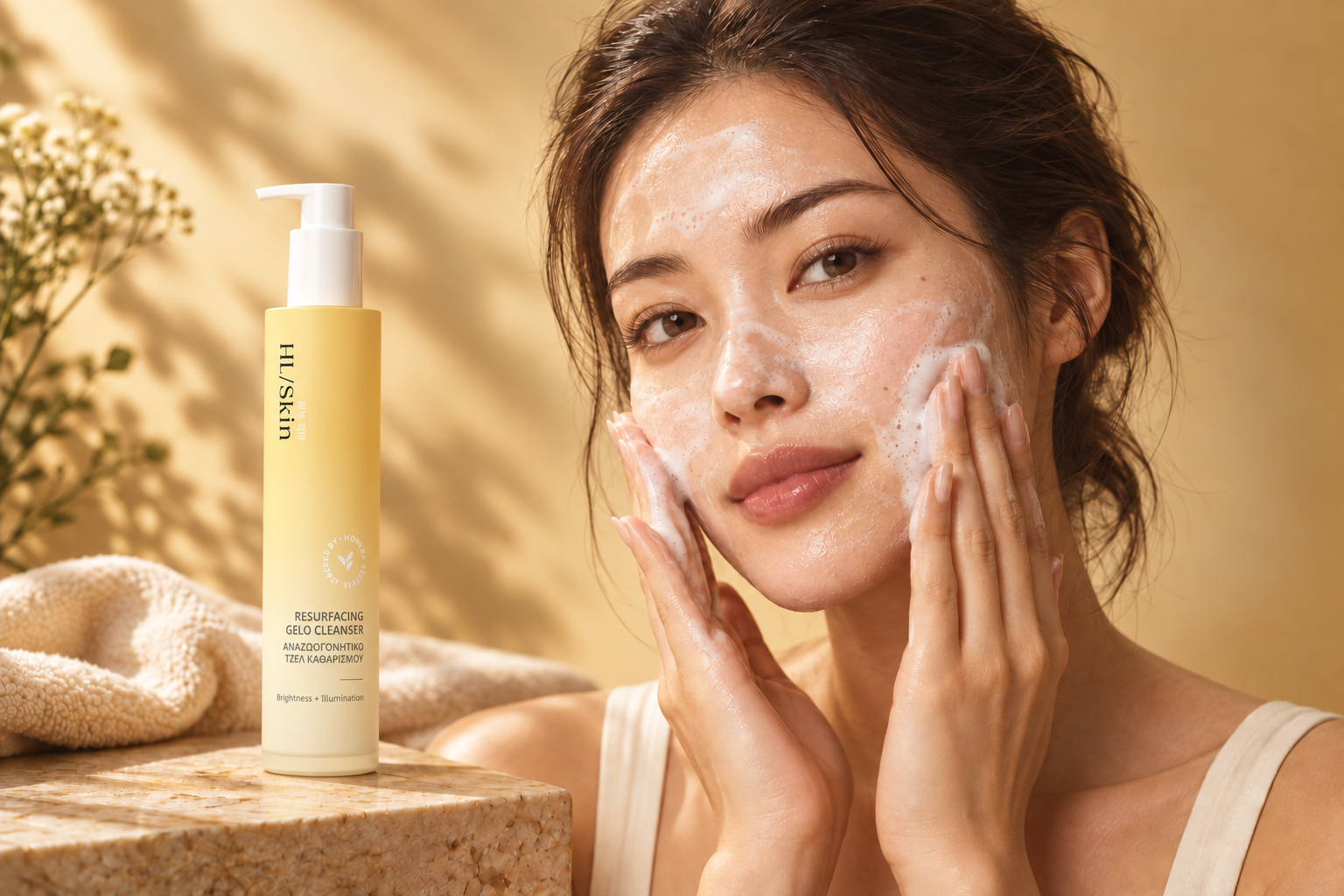
Almost every description of this cleanser says the same four things: lightweight, foaming, Korean-inspired, does not over-dry. None of them explains why it does not over-dry, which is the only part a buyer can actually verify.
The answer is on the back of the bottle. This guide works through all 42 ingredients in the order they are declared, explains what each group is doing, and separates the tested claims from the marketing language around them.
What it is, and where it is actually made
The HL/Skin line is Herbalife’s Korean-developed skincare range, and this cleanser sits in its Brightness & Illumination segment. The claim that it is "backed by advanced Korean skincare science" is not a positioning phrase invented in Europe — the label names the factory.
| Detail | As printed on the pack |
|---|---|
| Product code | 511K |
| Size | 147 ml (5.0 fl oz) |
| Format | Foaming gel cleanser, pump bottle |
| Manufactured by | Kolmar Korea Co., Ltd., 22-17 Sandan-gil, Jeonui-myeon, Sejong-si, Republic of Korea |
| Formula | Exclusive Herbalife formula, made in Korea |
| Brand owner | Herbalife International Luxembourg S.à.R.L., 16 Avenue de la Gare, L-1610 Luxembourg |
| Responsible person, UK | Herbalife Europe Limited, The Atrium, 1 Harefield Road, Uxbridge, Middlesex UB8 1HB |
| Testing | Dermatologically tested, ophthalmologically tested |
| Carton | FSC certified |
Naming a UK responsible person is a legal requirement for any cosmetic sold in Great Britain, and it is worth knowing who it is: that entity holds the product information file and the safety assessment behind everything claimed below.
The cleansing system: five surfactants, no sulphates
Cosmetic ingredient lists are ordered by descending concentration down to 1%. On this label, positions three and four — straight after water and glycerin — are both cleansing agents, and three more appear further down. Five in total, and the choice of those five is the whole story of this product.
| # | Surfactant (INCI) | Type and what it contributes |
|---|---|---|
| 3 | Disodium Cocoamphodiacetate | Amphoteric, coconut derived. One of the mildest surfactant classes in cosmetic use and the type commonly chosen for cleansers aimed at sensitive skin. |
| 4 | Disodium Cocoyl Glutamate | Anionic amino-acid surfactant, built on glutamic acid. Cleans effectively at a pH close to the skin’s own rather than requiring an alkaline formula. |
| 19 | Coco-Betaine | Amphoteric secondary surfactant. Builds foam and softens the action of the primary surfactants. |
| 20 | Sodium Methyl Oleoyl Taurate | Anionic taurate. Produces a dense, stable foam and performs well in hard water, which matters across much of the UK. |
| 27 | Coco-Glucoside | Non-ionic sugar-derived surfactant. Among the gentlest options available and widely used in baby and sensitive-skin formulas. |
Why this is the reason it does not strip the skin
The surfactants that cause most of the tightness people associate with washing their face are sulphates — sodium lauryl sulphate and sodium laureth sulphate. They clean powerfully and cheaply, and they also remove more of the skin’s own lipids than a milder system would. Neither appears anywhere on this label, which is what the "no added sulphates" statement on the pack refers to.
What replaces them is a blend of amphoteric, amino-acid, taurate and sugar-based surfactants. That combination is the standard approach in Korean cleanser formulation, and it is the direct, checkable reason behind the claim that the product cleanses without over-drying. It is not a texture impression — it is an ingredient choice you can read for yourself.
One easy misreading is worth clearing up. Betaine at position six is not a surfactant. It is trimethylglycine, a humectant that draws water into the skin, and it is a different substance from coco-betaine at position nineteen despite the similar name.
Three forms of hyaluronic acid in a rinse-off
Hyaluronic acid, ceramides and beta-glucan are normally leave-on actives. Putting them in a product that gets washed off within a minute is a deliberate formulation choice, and this label carries five of them in a row at positions thirteen to seventeen.
| # | Ingredient | What it is |
|---|---|---|
| 13 | Beta-Glucan | Polysaccharide, typically from oats or yeast. Forms a light film on the skin surface and holds water. |
| 14 | Hydrolyzed Hyaluronic Acid | Low molecular weight fragments, small enough to sit within the upper layers rather than only on top. |
| 15 | Ceramide NP | A skin-identical ceramide. Ceramides are a structural component of the skin’s own barrier lipids. |
| 16 | Sodium Hyaluronate | The sodium salt of hyaluronic acid — the standard, most stable form used in skincare. |
| 17 | Sodium Acetylated Hyaluronate | An acetylated derivative that binds to the skin surface more readily than plain hyaluronate, so more of it survives the rinse. |
The last entry explains the logic. A cleanser is rinsed away, so any water-soluble humectant largely leaves with it. Acetylated hyaluronate is modified specifically to be more substantive on skin, and pairing it with the standard and hydrolysed forms means something remains after the water has gone. That, together with the surfactant choice, is the mechanism behind the reported "instantly softened" result.
The Korean botanical set
Four botanical extracts and one prebiotic sugar sit between the texturiser and the hydration group. They are the ingredients that most clearly mark this out as a Korean formula rather than a European one.
- Centella Asiatica Extract (position 11) — known in Korean skincare as cica, and probably the single most recognisable ingredient in the whole category.
- Eclipta Prostrata Leaf Extract (position 9) — false daisy, a plant with a long history of use across East and South Asia.
- Ficus Carica (Fig) Fruit Extract (position 12) — the fruit component referred to in Herbalife’s own description of the formula.
- Laminaria Japonica Extract (position 35) — kombu kelp, a staple marine ingredient in Korean and Japanese formulation.
- Fructooligosaccharides (position 10) — a prebiotic sugar, included in cleansers to support the skin’s surface microbial balance.
Two more plant-derived entries appear near the end: Zea Mays (Corn) Germ Oil and Hydrogenated Lecithin, the latter acting as an emulsifier that helps the oil-soluble components disperse in a water-based gel.
Preservatives, chelation and pH
The pack states no added parabens, and the ingredient list bears that out. Preservation is handled by a multifunctional blend instead, which is the current standard approach in Korean formulation.
- Potassium Benzoate, 1,2-Hexanediol, Caprylyl Glycol, Glyceryl Caprylate and Ethylhexylglycerin — five ingredients that each contribute preservation alongside a second function such as humectancy or skin conditioning.
- Sodium Phytate (position 31) is the chelating agent, used to bind trace metal ions that would otherwise destabilise the formula. It is derived from phytic acid, and its presence means there is no EDTA in this product.
- Citric Acid (position 7) adjusts pH, and Hydroxypropyl Starch Phosphate (position 8) is the starch-derived thickener that gives the gel its texture before it foams.
- Pentaerythrityl Tetra-Di-T-butyl Hydroxyhydrocinnamate (position 42) is an antioxidant protecting the oil phase from oxidising.
The full ingredient list and fragrance allergens
Fragrance allergens declared on this label
The product is fragranced (Parfum) and declares several fragrance components individually: Tetramethyl Acetyloctahydronaphthalenes, Linalyl Acetate, Terpineol, Acetyl Cedrene and Pinene.
This is worth noticing. None of those first four appears on the long-standing list of 26 fragrance allergens that cosmetics have been declaring for years — they are all on the expanded list introduced by Commission Regulation (EU) 2023/1545, which raised the number of individually declarable fragrance substances to around eighty. In a rinse-off product such as this one, declaration is required once a listed substance exceeds 0.01%. In short, this is a label written to the newer and stricter fragrance rules, not the older ones.
If you have a known reaction to any of these, or react to fragranced cleansers generally, this is not the right product for you. If you are unsure, patch test on a small area of inner forearm and leave it 24 hours before using it on your face.
What the 100%, 96% and 93% figures actually measured
Three percentage figures appear in the product’s official description, and all three come from the same consumer study: 32 women aged 25 to 60. The figures are real, but they measure different things, and the distinction is the part nobody publishes.
| Claim | Result | How it was measured | When |
|---|---|---|---|
| Reduces oiliness on the face and removes all dirt and impurities | 100% agree | Participant self-assessment | After 30 days |
| Purifies and cleanses the pores, skin feels and looks healthy | 96% agree | Participant self-assessment | After 30 days |
| Skin feels instantly softened | 93% agree | Participant self-assessment | After one use |
| Gently cleanses without over-drying | — | Instrumental measurement | Immediate and after 30 days |
| Removes excess sebum | — | Instrumental measurement | Immediate and after 30 days |
How to read that table
The three percentages are what people reported about their own skin. That is a legitimate and standard form of cosmetic testing, and it is what the footnotes on the pack say. It is not the same as a machine reading.
The two claims carrying no percentage are the ones backed by instruments rather than opinion: hydration and sebum were measured directly, immediately after use and again after thirty days. Those are the more demanding of the two evidence types, and they are the claims underpinning the central promise that this cleanser does not dry the skin out.
Thirty-two participants is a small panel by clinical standards, and normal for cosmetic substantiation. Knowing which number came from an instrument and which came from a questionnaire is what lets you weigh them properly.
How to use it
The directions on the pack are short, and each step exists for a reason.
- Apply to wet hands and work into a light foam. Foaming it in your palms first means the surfactants are already diluted and aerated when they reach your face, rather than arriving as concentrated gel on one spot.
- Massage gently in circular motions over the face and neck. The neck is included in the instruction and is the part most people skip.
- Rinse thoroughly with warm water and pat dry. Warm rather than hot; pat rather than rub.
- Use morning and evening for best results. The consumer study ran on twice-daily use over thirty days, so that is the pattern the figures above describe.
Cautions from the label
Keep out of reach of children. For external use only. Avoid direct contact with the eyes. If you have a diagnosed skin condition affecting the face, are using prescription topical treatments, or notice persistent irritation, speak to your GP or pharmacist rather than working through it.

HL/Skin Resurfacing Gelo Cleanser, 147 ml
Five sulphate-free surfactants, three forms of hyaluronic acid and ceramide NP in a foaming gel. Dermatologically and ophthalmologically tested, no added parabens or sulphates. Made in Korea, shipped from the official Herbalife UK warehouse.
View ProductWhere it fits in an HL/Skin routine
Cleansing is the first step of any routine, morning and evening. Everything applied afterwards — toner, serum, moisturiser, sunscreen — lands on skin this product has just prepared, which is why a cleanser that strips the barrier undermines whatever follows it.
The rest of the HL/Skin range is designed to layer on top. If you are building the full sequence, the order for every Herbalife skincare product is set out in the Herbalife skincare routine guide, and the complete range specification is in the HL/Skin official FAQ. For the morning step that goes on last, see the Protective Moisturiser SPF 30 breakdown.


Frequently asked questions
Does HL/Skin Resurfacing Gelo Cleanser contain sulphates?
No. The pack states no added sulphates, and neither sodium lauryl sulphate nor sodium laureth sulphate appears on the ingredient list. Cleansing is handled instead by five milder surfactants: disodium cocoamphodiacetate, disodium cocoyl glutamate, coco-betaine, sodium methyl oleoyl taurate and coco-glucoside.
Does it contain parabens?
No. The preservation system is built from potassium benzoate, 1,2-hexanediol, caprylyl glycol, glyceryl caprylate and ethylhexylglycerin, each of which performs a second function in the formula alongside preservation.
Where is the Gelo Cleanser made?
In South Korea. The label names the manufacturer as Kolmar Korea Co., Ltd., at 22-17 Sandan-gil, Jeonui-myeon, Sejong-si, Republic of Korea, and describes the product as an exclusive Herbalife formula made in Korea.
Does it really contain hyaluronic acid?
Three forms of it: hydrolyzed hyaluronic acid, sodium hyaluronate and sodium acetylated hyaluronate, at positions 14, 16 and 17 on the ingredient list, alongside ceramide NP and beta-glucan. The acetylated form is the one modified to adhere to the skin surface, so some of it remains after rinsing.
Is it suitable for oily skin?
The pack describes it as suitable for diverse skin types, and the product’s instrumental testing covered removal of excess sebum. As with any cleanser, how it performs on your own skin depends on your barrier condition and what else is in your routine.
What do the 100%, 96% and 93% figures mean?
All three come from a study of 32 women aged 25 to 60 and are participant self-assessments — 100% and 96% after thirty days of use, 93% after a single use. The separate claims about cleansing without over-drying and removing excess sebum were assessed by instrumental measurement rather than by questionnaire.
Is it fragranced?
Yes. Parfum is at position 26, and five fragrance components are declared individually: tetramethyl acetyloctahydronaphthalenes, linalyl acetate, terpineol, acetyl cedrene and pinene. Four of those are on the expanded fragrance allergen list introduced by Commission Regulation (EU) 2023/1545 rather than on the older list of 26.
How often should it be used?
Morning and evening, which is what the label directs and what the consumer study was based on. Apply to wet hands, work into a light foam, massage in circular motions over face and neck, then rinse thoroughly with warm water and pat dry.
How long does a 147 ml bottle last?
That depends on how much you dispense, which the label does not specify. As a guide, a single pump worked into a foam is typically enough for face and neck, and at twice-daily use most people find a bottle of this size lasts a couple of months.
Sources & references
- Official product label, Herbalife HL/Skin Resurfacing Gelo Cleanser 147 ml, artwork reference CUT511KV1-00, ©2025 Herbalife — ingredient list, directions, cautions, manufacturer and responsible person details.
- Herbalife HL/Skin Resurfacing Gelo Cleanser Fact Sheet, SKU 511K, ©2025 Herbalife Europe Limited — key benefits, how to use and full INCI declaration.
- Herbalife official product claim footnotes — consumer study of 32 women aged 25 to 60, instrumental measurements and self-assessment results at immediate use and 30 days.
- Commission Regulation (EU) 2023/1545 amending Regulation (EC) No 1223/2009 as regards labelling of fragrance allergens in cosmetic products.
- COSlaw — expanded fragrance allergen labelling, including the 0.01% declaration threshold for rinse-off products.
Dogus Dilan — Herbalife Independent Member / Wellness Coach
Writes every guide on this site from official Herbalife product labels and published data rather than marketing copy. As a Herbalife Independent Member, the products discussed here are sold through this shop.