
Herbalife SKIN Protective Moisturiser SPF 30: Every UV Filter Explained
Herbalife SKIN Protective Moisturiser SPF 30 is a 50 mL broad spectrum facial sunscreen built on five organic UV filters: homosalate, ethylhexyl salicylate, benzophenone-3, butyl methoxydibenzoylmethane and octocrylene. Those five sit at positions two, three, four, eight and nine on the ingredient list, which is where the bulk of any formula is declared — this is a sunscreen that moisturises rather than a moisturiser with a little SPF added. It also carries niacinamide, ascorbyl glucoside, vitamin E and aloe vera leaf juice. In Great Britain an SPF 30 product may only claim UVA protection if its measured UVA protection factor reaches at least 10 and its critical wavelength reaches 370 nm. The label states "Contains benzophenone-3", which is a mandatory declaration rather than a health warning.
What this guide covers

Most write-ups of this product stop at "broad spectrum UVA/UVB, lightweight, non-greasy". That tells you nothing you could not read off the front of the bottle, and it leaves the two questions people actually have unanswered: what is doing the protecting, and why does the label name one ingredient in a warning.
This guide works through the official ingredient list line by line. Every claim below is traceable either to the product label or to the cosmetics rules that apply to sunscreens sold in Great Britain.
What SPF 30 and broad spectrum mean in the UK
Sunscreens are regulated as cosmetics in Great Britain, not as medicines, and the SPF number on the front is a measured laboratory value rather than a marketing choice. Two separate figures sit behind the words on this bottle.
The SPF number describes UVB performance. An SPF of 30 corresponds to filtering roughly 96.7% of UVB radiation under test conditions. The arithmetic is simple: SPF 15 is about 93.3%, SPF 30 about 96.7%, SPF 50 about 98%. The gap between 30 and 50 is far smaller than the numbers suggest, which is why the labelling categories group them together — SPF 30 and SPF 50 both fall in the "high protection" band.
The UVA claim has its own threshold. Under Commission Recommendation 2006/647/EC, which remains the working standard for sunscreens in the UK and the EU, a product may only carry a UVA claim if its measured UVA protection factor is at least one third of the labelled SPF, and if its critical wavelength reaches at least 370 nm. For an SPF 30 product that means a UVA protection factor of 10 or above. Products meeting both conditions may display the UVA-in-a-circle logo.
What no sunscreen is allowed to claim
The same recommendation prohibits claims implying total or permanent protection. Terms such as "sunblock", "100% protection" and "all-day protection" cannot be used on any sunscreen sold in Great Britain or the EU, regardless of SPF. If you see them, the product is not compliant. This is worth knowing because it sets the honest ceiling for what SPF 30 does: it reduces UV reaching the skin substantially, and it needs reapplying.
The five UV filters, decoded
Cosmetic ingredient lists are ordered by descending concentration down to 1%. On this label the five UV filters occupy positions two, three, four, eight and nine, immediately after water — the top of the list, where the substance of the formula sits. Each covers a different part of the spectrum, and they are chosen to work as a set rather than individually.
| Filter (INCI name) | Also known as | Part of the spectrum it absorbs |
|---|---|---|
| Homosalate | Homomenthyl salicylate | UVB — the shorter, burning wavelengths |
| Ethylhexyl Salicylate | Octisalate | UVB; also helps dissolve the other filters into the formula |
| Benzophenone-3 | Oxybenzone | UVB and short-wave UVA (UVA II) |
| Butyl Methoxydibenzoylmethane | Avobenzone | Long-wave UVA (UVA I), reaching towards 400 nm |
| Octocrylene | — | UVB and short-wave UVA; also photostabilises avobenzone |
The last row is the one worth pausing on. Avobenzone is the only widely used organic filter that reaches deep into the long UVA range, and it is also the one that degrades fastest under sunlight on its own. Octocrylene is routinely paired with it precisely because it slows that breakdown. Seeing both on the same label is a sign the formula was built around keeping UVA coverage stable through wear, not just achieving a number on a test strip.
All five are organic filters. There is no zinc oxide or titanium dioxide in this formula, which is the practical reason it absorbs without the white cast mineral sunscreens leave, and why it sits under makeup rather than under it.
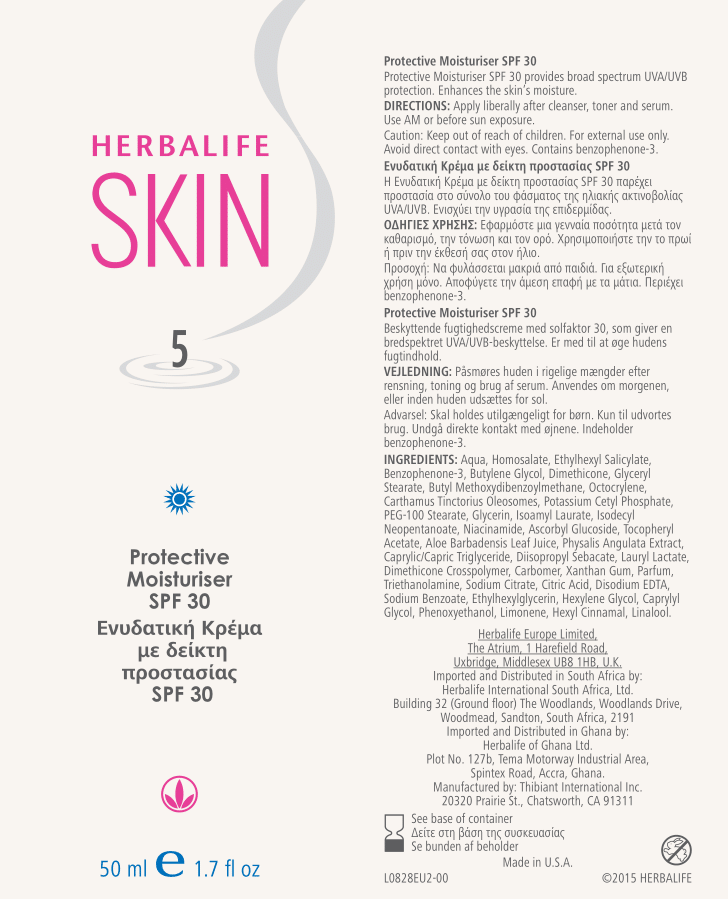
Why the label says "Contains benzophenone-3"
This sentence appears on the pack, and it is the single thing people most often misread. It is not a safety warning issued because something went wrong. It is a labelling requirement written into the cosmetics rules.
Benzophenone-3 is an authorised UV filter with defined limits. In face, hand and lip products — excluding sprays — the maximum permitted concentration is 6%. In body products including sprays it is 2.2%. Where benzophenone-3 is used only to protect the formula itself rather than as a UV filter, the limit is 0.5%. And wherever it is present above 0.5%, the declaration "Contains benzophenone-3" must appear on the packaging.
What the limits mean for a face product
This is a 50 mL facial moisturiser, so it falls under the 6% category rather than the stricter 2.2% body limit. The declaration on the pack tells you benzophenone-3 is present above 0.5% and is doing UV filtering work. It does not tell you the exact percentage, and Herbalife does not publish it — cosmetic ingredient lists give order, not quantities.
These limits were tightened in 2022 following a review by the EU Scientific Committee on Consumer Safety, and the reduced figures have applied to all products on the market since July 2023. A product carrying the declaration today is a product formulated within the current limits.
If you prefer to avoid benzophenone-3 for your own reasons, the honest answer is that this product is not the one for you, and the sister product in the range — Daily Glow Moisturiser — contains no UV filters at all. That comparison is set out further down.
The rest of the formula
Below the filters, the list moves into the moisturising base and the additional ingredients. These are the ones the marketing usually leads with, and it is worth being clear about where they actually sit.
| Ingredient (INCI) | Commonly called | Role in this formula |
|---|---|---|
| Niacinamide | Vitamin B3 | Widely used skincare active; present here below the 1% ordering threshold territory |
| Ascorbyl Glucoside | A stable vitamin C derivative | More photostable than pure ascorbic acid, which matters in a product worn in sunlight |
| Tocopheryl Acetate | Vitamin E | Antioxidant, also helps protect the oil phase of the formula |
| Aloe Barbadensis Leaf Juice | Aloe vera | The aloe base shared across the Herbalife SKIN range |
| Carthamus Tinctorius Oleosomes | Safflower oleosomes | Intact plant oil bodies used as a natural delivery and emollient system |
| Physalis Angulata Extract | Cutleaf groundcherry extract | Botanical extract used in the SKIN range |
| Glycerin, Butylene Glycol | Humectants | Draw and hold water in the upper layers of the skin |
| Dimethicone, Dimethicone Crosspolymer | Silicones | Produce the slip and the smooth, non-tacky finish under makeup |
One correction worth making
The Herbalife SKIN moisturiser range is often described as containing macadamia nut oil. On the official ingredient list for this particular product, it does not appear — the plant oil component here is Carthamus tinctorius oleosomes, which is safflower, a different plant entirely. Where descriptions of this product mention macadamia, they do not match the label in front of you. This guide reports the label.
The full ingredient list and allergens
Fragrance allergens declared on this label
This product is fragranced (Parfum) and declares three named fragrance allergens: Limonene, Hexyl Cinnamal and Linalool. These appear at the end of the list because cosmetics rules require named fragrance allergens to be declared separately once they exceed a set threshold in a leave-on product.
If you have a known reaction to any of the three, or to benzophenone-3, this is not a suitable product for you. If you are unsure, patch test on a small area of inner forearm and leave it 24 hours before applying to the face.
How much to apply, and when
This is the part that changes the result more than anything else on the label, and it is almost never mentioned. An SPF figure is measured in the laboratory at an application density of 2 mg per square centimetre of skin. Most people apply considerably less than that in daily use, and because the relationship is not linear, applying roughly half the test amount does not give you half the protection — it gives you noticeably less than half.
The practical measure
- Face and neck: around a quarter of a teaspoon, or roughly 1.2 mL. If you are using a finger measure, a line of product along the full length of the index finger and the middle finger is the usual equivalent.
- Timing: the label directs applying 15 minutes before sun exposure, which gives the film time to settle evenly on the skin.
- Reapplying: the label states it is suitable for daily use and that best results come from use throughout the day. In practice that means topping up after a couple of hours outdoors, and after sweating or towelling.
- Order in a routine: apply after cleanser, toner and serum, as the final leave-on step before makeup.
A 50 mL bottle used at the correct face-and-neck dose gives roughly 40 applications. If a bottle is lasting you several months of daily use, the amount going on is well under the tested dose.
SPF 30 or Daily Glow? Which to reach for
These two products are frequently confused because they sit side by side in the same range and are both 50 mL facial moisturisers. They are not interchangeable, and the difference is not subtle.
Protective Moisturiser SPF 30 is a sunscreen. Five UV filters make up the top of its ingredient list, and it is the one to use in the morning and before any sun exposure. Daily Glow Moisturiser contains no UV filters and is a straightforward hydrating moisturiser — the one for evenings, or for anyone who prefers a separate sunscreen step.
Plenty of people in the UK use both: SPF 30 in the morning, Daily Glow at night. If you are building a full routine around the range, the step-by-step order for every Herbalife SKIN product is set out in the Herbalife SKIN care routine guide.
Where to buy

Herbalife SKIN Protective Moisturiser SPF 30, 50 mL
Broad spectrum SPF 30 on five organic UV filters, with niacinamide, ascorbyl glucoside, vitamin E and aloe vera. The morning step, and the one to use before sun exposure.
View Product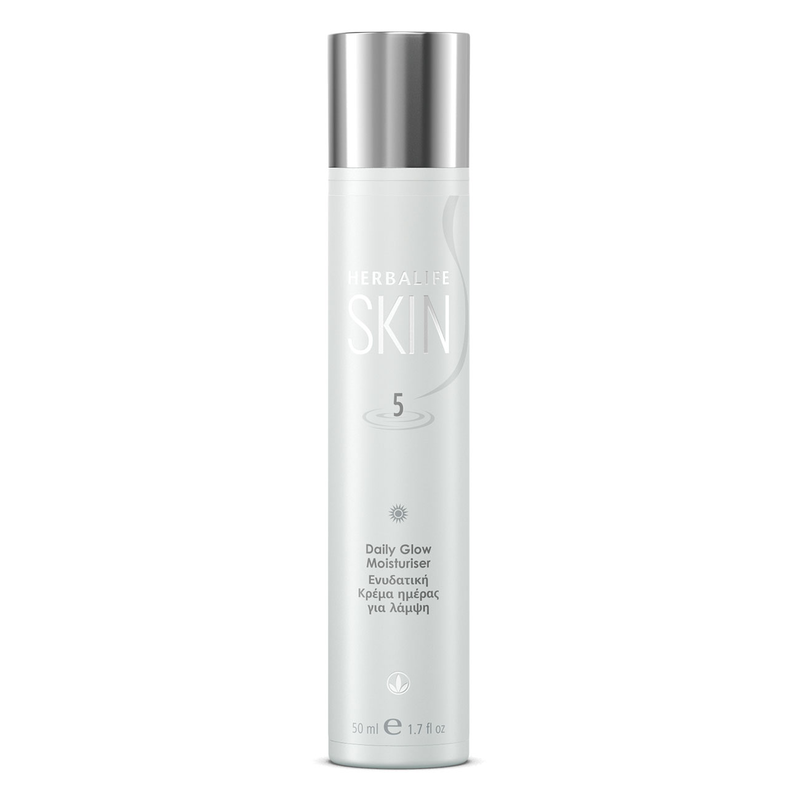
Herbalife SKIN Daily Glow Moisturiser, 50 mL
The same range without UV filters — hydration only. The evening counterpart, and the choice for anyone who would rather keep sunscreen as a separate step.
View ProductBefore you use it
For external use only. Avoid direct contact with the eyes and keep out of reach of children. If you take medication that increases sensitivity to sunlight, have a skin condition affecting the face, or have noticed any change in a mole or patch of skin, speak to your GP or pharmacist rather than relying on a cosmetic product to manage it.
Frequently asked questions
What UV filters does Herbalife SKIN Protective Moisturiser SPF 30 contain?
Five organic filters: homosalate, ethylhexyl salicylate, benzophenone-3, butyl methoxydibenzoylmethane (avobenzone) and octocrylene. They occupy positions two, three, four, eight and nine on the ingredient list. There is no zinc oxide or titanium dioxide in the formula.
Why does the label say "Contains benzophenone-3"?
It is a mandatory labelling declaration, not a health warning. Cosmetics rules require the phrase on packaging wherever benzophenone-3 is present above 0.5%. In face products the permitted maximum is 6%, and the limits were reviewed and tightened in 2022, with the current figures applying to all products on the market since July 2023.
How much UVB does SPF 30 filter?
Roughly 96.7% under test conditions. SPF 15 filters about 93.3% and SPF 50 about 98%, which is why SPF 30 and SPF 50 are both classed in the same "high protection" labelling band rather than treated as very different products.
What does broad spectrum actually require?
Under Commission Recommendation 2006/647/EC, a sunscreen sold in the UK or EU may only carry a UVA claim if its measured UVA protection factor is at least one third of the labelled SPF, and its critical wavelength reaches at least 370 nm. For an SPF 30 product that means a UVA protection factor of 10 or more.
How much should I apply to my face?
Around a quarter of a teaspoon, or roughly 1.2 mL, for face and neck. SPF values are measured at 2 mg per square centimetre of skin, and applying noticeably less gives noticeably less protection than the number on the bottle suggests. A 50 mL bottle used at the correct dose lasts around 40 applications.
Does it contain macadamia nut oil?
No. The official ingredient list for this product names Carthamus tinctorius oleosomes, which is safflower, and does not list any macadamia-derived ingredient. Descriptions mentioning macadamia do not match the label on this particular product.
Is it suitable for use under makeup?
The formula is built on organic filters with dimethicone and dimethicone crosspolymer in the base, which is the combination that produces a smooth, non-tacky finish and no white cast. Apply it as the final leave-on step after serum, and give it a few minutes to settle before makeup.
Does it contain fragrance allergens?
Yes. It is fragranced and declares three named fragrance allergens at the end of the ingredient list: limonene, hexyl cinnamal and linalool. Anyone with a known sensitivity to these should avoid the product or patch test first.
What is the difference between this and Daily Glow Moisturiser?
Protective Moisturiser SPF 30 is a sunscreen, with five UV filters at the top of its ingredient list. Daily Glow Moisturiser contains no UV filters and is a hydrating moisturiser only. The usual pairing is SPF 30 in the morning and Daily Glow in the evening.
Sources & references
- Official product label and ingredient list, Herbalife SKIN Protective Moisturiser SPF 30 50 mL, product code 0828, MPN 0828EU — reproduced in full above.
- Commission Regulation (EU) 2017/238 amending Annex VI to Regulation (EC) No 1223/2009 — benzophenone-3 as an authorised UV filter.
- Commission Regulation (EU) 2022/1176 — revised maximum concentrations for benzophenone-3 and octocrylene, applicable to all products on the market from July 2023.
- CTPA regulatory update on sunscreen standards — the UVA-in-a-circle logo and the one-third rule as applied in the UK.
- Commission Recommendation 2006/647/EC on the efficacy of sunscreen products — minimum SPF, UVA protection factor ratio, critical wavelength and prohibited claims.